Imagine waking up during a power outage and hearing nothing. The refrigerator is off. The Wi-Fi is down. Your phone battery is almost empty. In that moment, one question matters more than any other: what can a 1000Wh power station run?
The answer affects food safety, internet access, medical equipment, and overall peace of mind. Many people buy a portable power station expecting it to power everything. However, battery capacity has limits, and knowing those limits helps you avoid costly mistakes.
Fortunately, a 1000Wh power station can run many essential devices during emergencies, camping trips, and off-grid adventures. In this guide, you’ll learn exactly what can a 1000Wh power station run, realistic runtime expectations, common limitations, and how to get the most backup power from your battery.
Quick Answer: What Can a 1000Wh Power Station Run?
A 1000Wh power station can typically run:
- Refrigerators
- Freezers
- CPAP machines
- Routers and modems
- Starlink systems
- Laptops
- Phones and tablets
- TVs
- Fans
- Lights
- Small power tools
However, high-power appliances such as space heaters drain the battery very quickly.
In real-world conditions, most users get roughly 800Wh of usable energy after inverter losses and power conversion inefficiencies.
Therefore, a 1000Wh power station works best for essential backup power rather than whole-home operation.
Why Knowing What a 1000Wh Power Station Can Run Matters
Battery capacity sounds simple on paper. However, real-world performance depends on the appliance you connect.
For example, a router may run for many hours. Meanwhile, a heater can drain the battery in less than an hour.
This difference matters during emergencies. If you understand what a 1000Wh power station can run, you can prioritize the devices that truly matter.
As a result, you can keep food cold, stay connected, and power medical equipment without unexpected surprises.
How a 1000Wh Power Station Solves Backup Power Problems
User experiences from the Anker Solix C1000 , EcoFlow Delta 3 Classic, and Jackery Explorer 1000 v2 show a consistent pattern.
Owners most often use these power stations for:
- Refrigerator backup
- Internet equipment
- CPAP therapy
- Emergency home power
- Camping trips
- RV travel
- Starlink internet
- Small business equipment
In addition, users frequently rely on them during storms and unexpected outages.
Most models in this category provide around 1000Wh to 1024Wh of battery capacity and enough inverter power to run several essential devices at the same time.
What Can a 1000Wh Power Station Run During a Power Outage?
Refrigerators and Freezers
Refrigerators are among the most common backup power applications.
Many users reported successfully powering refrigerators for several hours during outages.
However, runtime depends on compressor cycles, room temperature, and refrigerator size.
For a detailed breakdown, see: How long will a 1000Wh station run a fridge?
CPAP Machines
CPAP users often need reliable overnight power.
Real-world reports show that a 1000Wh power station can support multiple nights of CPAP use depending on machine settings and whether the heated humidifier is enabled.
For setup guidance, see: How to power a CPAP with a 1000Wh power station
Routers, Modems, and Starlink
Internet equipment uses relatively little power.
Therefore, routers, modems, and Starlink systems are excellent candidates for battery backup.
Many users rely on these devices to stay connected during extended outages.
Laptops, Phones, and Electronics
Most personal electronics consume modest amounts of energy.
As a result, a 1000Wh power station can recharge phones multiple times and power laptops throughout a workday.
Small Tools
Many users successfully powered small tools on job sites and during DIY projects.
However, some high-surge equipment may exceed startup limits.
Therefore, testing tools before relying on them is always a good idea.
Common Problems Users Mentioned and How This Product Helps
High-Power Appliances Drain the Battery Fast
One of the most common surprises involves electric heaters.
User reports showed that 1200W to 1500W heaters can consume the battery in roughly 30 minutes.
Therefore, a 1000Wh power station is not a practical overnight heating solution.
Refrigerator Runtime Can Be Shorter Than Expected
Some users expected refrigerators to run much longer.
However, startup surges and compressor cycles increase energy consumption.
Even so, refrigerators remain one of the most popular and effective uses for a 1000Wh battery.
Medical Device Runtime Varies
One oxygen concentrator user reported approximately 3 to 3.5 hours of operation at around 310W.
Therefore, medical equipment users should always calculate actual power draw before an emergency.
Device Compatibility Can Be Limited
Some users reported issues with diesel heaters, air compressors, pumps, and specialty equipment.
As a result, testing critical appliances before an outage remains one of the best preparation strategies.
Step-by-Step Guide to Calculate What a 1000Wh Power Station Can Run
First, Find the Appliance Wattage
Look for the wattage label on the device.
Common examples include:
- Router: 10–20W
- Laptop: 40–100W
- CPAP: 30–90W
- Refrigerator: 50–150W average
- TV: 50–200W
Next, Estimate Usable Battery Capacity
A 1000Wh battery does not deliver the full rated capacity.
Most users should estimate:
1000Wh × 80% = 800Wh usable energy
Then Calculate Runtime
Use this formula:
Runtime = Usable Wh ÷ Device Watts
For example:
- 20W router = about 40 hours
- 50W CPAP = about 16 hours
- 60W laptop = about 13 hours
- 70W refrigerator = about 11 hours
Finally, Prioritize Essential Loads
During an outage, power these devices first:
- Medical equipment
- Refrigeration
- Internet equipment
- Phones
- Lighting
This strategy maximizes battery runtime.
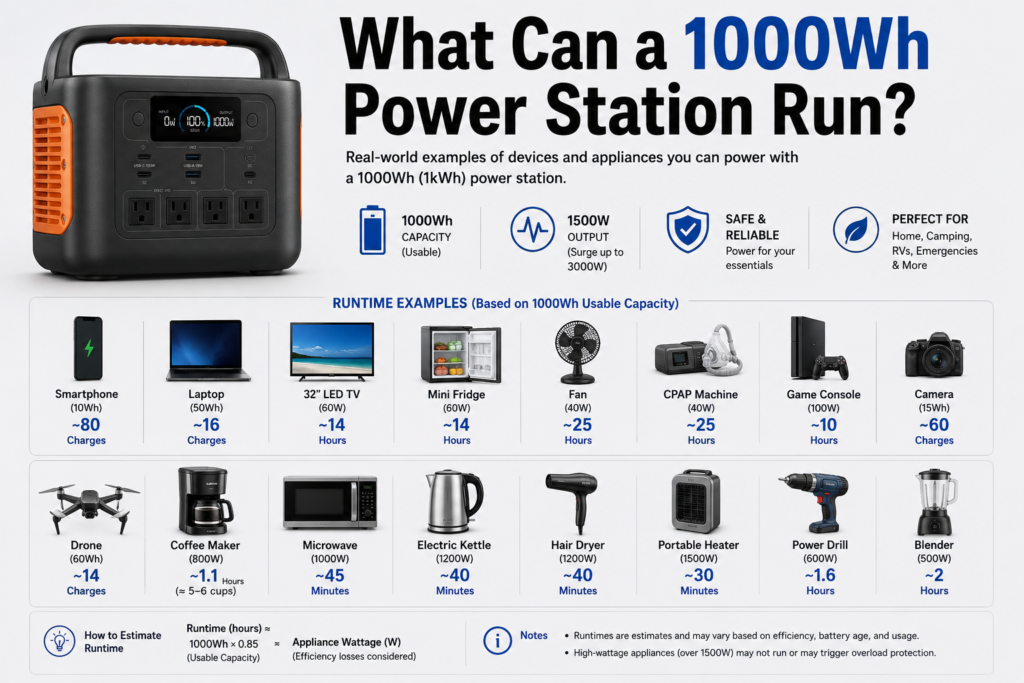
Runtime Estimates for Common Appliances
Real-world performance varies. In addition, inverter losses and usage patterns affect results.
Based on user reports:
| Device | Approximate Runtime |
|---|---|
| Router and modem (~55W) | 14–15 hours |
| Refrigerator | 7–15 hours |
| CPAP machine | Multiple nights |
| Oxygen concentrator (~310W) | 3–3.5 hours |
| Electronics and laptops | Up to 19 hours combined use |
Pros and Cons of What a 1000Wh Power Station Can Run
Pros
- Powers refrigerators during outages
- Excellent CPAP backup solution
- Supports internet equipment
- Runs laptops and phones for many hours
- Useful for camping and RV travel
- Handles many small appliances
- Fast recharging on popular models
Cons
- Heaters drain batteries rapidly
- Some pumps may not start
- Actual capacity is lower than rated capacity
- Certain tools may exceed surge limits
- Runtime depends heavily on appliance wattage
Who Benefits Most From a 1000Wh Power Station?
A 1000Wh power station is ideal for:
- Homeowners preparing for outages
- CPAP users
- RV travelers
- Campers
- Remote workers
- Starlink users
- Apartment residents
In addition, it works well for anyone seeking reliable emergency backup power.
For broader preparedness planning, see: Is 1000Wh enough for home backup?
When a 1000Wh Power Station May Not Be Enough
A larger battery system may be necessary if you need to run:
- Electric heaters overnight
- Large well pumps
- Air conditioners
- Multiple refrigerators
- Whole-home backup systems
In these situations, additional battery capacity becomes more important than inverter power.
Frequently Asked Questions
What can a 1000Wh power station run during a blackout?
A 1000Wh power station can run refrigerators, routers, CPAP machines, phones, laptops, lights, and other essential electronics.
Can a 1000Wh power station run a refrigerator?
Yes. User reports commonly showed refrigerator runtimes between roughly 7 and 15 hours depending on usage.
How long can a 1000Wh power station run a CPAP machine?
Many users reported multiple nights of CPAP operation, although settings and humidifier use affect runtime.
What can a 1000Wh power station run continuously?
Lower-power devices such as routers, modems, lights, and laptops can often run for many hours continuously.
Can a 1000Wh power station run a heater?
Yes, but only briefly. User reports showed 1200W–1500W heaters draining the battery in about 30 minutes.
Is a 1000Wh power station enough for emergency backup?
Yes, for essential devices. However, it is not designed for whole-home backup or long-term heating loads.
Final Verdict
So, what can a 1000Wh power station run?
For most people, the answer is all the essentials. A 1000Wh power station can run refrigerators, CPAP machines, routers, laptops, phones, lights, Starlink systems, and many small appliances.
However, it is not a replacement for whole-home backup power. High-draw appliances such as heaters and large pumps can exhaust the battery quickly.
If your goal is reliable emergency power, camping power, or backup energy for critical devices, a 1000Wh power station offers one of the best balances of battery capacity, portability, and real-world usefulness.